Maryland Has a Strong Innovation Story. We Need to Tell It Better.
Maryland has no shortage of innovation assets. From world-class research institutions and federal laboratories to a highly educated workforce and a growing network of technology companies, our state has many of the ingredients needed to compete in today’s innovation economy.
But having these assets and telling a compelling story about how they come together to create economic opportunity are two different things. Businesses and investors need to understand not just what Maryland has, but what makes it a place where ideas can become companies, companies can grow, and industries can take shape.
That story is being built across Maryland, with each region contributing its own strengths and opportunities.
In Howard County, one example is the Gateway Innovation District.
In October 2025, Howard County took a major step toward reshaping its innovation economy. County Executive Calvin Ball signed the Gateway Master Plan, a 30-year vision to transform the 1,100-acre Columbia Gateway Business Park into an Innovation District. The plan envisions a different kind of business district: one where research institutions, startups, established companies, housing, and public spaces come together to make collaboration easier and attract the next generation of businesses. The County Council approved the plan on October 6, and Ball signed it three days later.
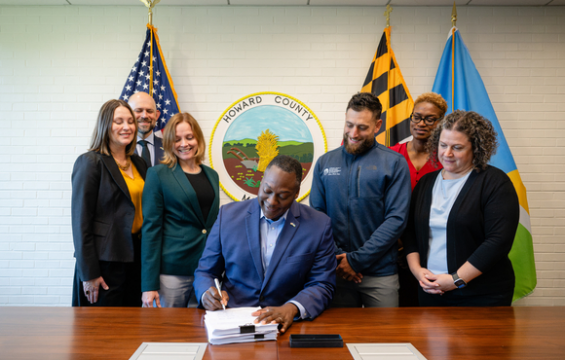
County Executive Calvin Ball signs the Gateway Master Plan, advancing a 30-year vision for Columbia Gateway as an innovation district.
The ambition isn’t coming out of nowhere. Among the 410 U.S. counties with at least 50,000 jobs, Howard County has the highest combined density of science and software employment in the country, according to a recent Technical.ly analysis. Its research employment density is close to 10 times the national rate, while its software employment density is 4.5 times the national rate. Few counties are as concentrated in both categories at once.
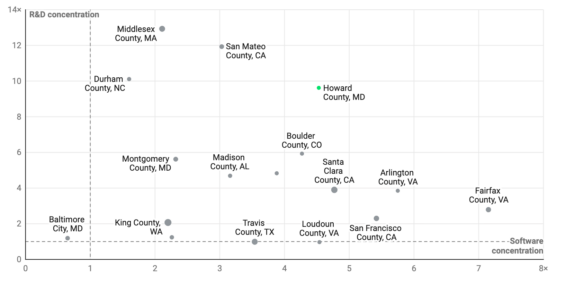
Howard County stands out for its concentration of both research and software employment, as shown in this comparison of U.S. counties.
But having an innovation economy and being recognized for one are two different things. At the September BannerX life sciences panel, industry leaders kept landing on the same frustration: Maryland doesn’t know how to describe itself to the outside world. One panelist said investors elsewhere simply haven’t encountered a Maryland success story, so they have no reason to extend trust.
Another argued the state’s own research institutions are so used to their surroundings that they’ve stopped noticing how rare this concentration actually is.The perception was that Maryland had plenty of federal contractors but little innovation of its own. That characterization no longer holds up. The gap between how Howard County is perceived and what it is actually producing has become too wide to ignore.
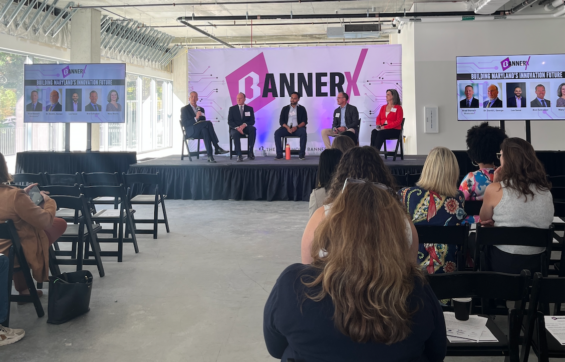
BannerX panelists discuss Maryland’s innovation economy and the challenge of turning its research strengths into a stronger national reputation.
The same density that’s our strength is also our exposure
Our research weight comes almost entirely from one institution. The Johns Hopkins Applied Physics Laboratory in Laurel employs more than 8,800 people. Remove it from the county’s totals, and much of that research density disappears with it. Software looks like the opposite problem: more than 1,000 small firms averaging 11 employees each, a long tail of contractors and solo operators rather than a cluster of large product companies.
That same structure is what left us exposed when federal contracting slowed down. Maryland lost close to 30,000 federal jobs between January 2025 and March 2026, second only to California, and computer systems design employment in Howard County dropped 4.2% in a single year. It’s the same vulnerability the September panelists described in plainer terms: research funding that gets rewritten every election cycle, and a commercialization process in a field where a single drug can consume $100 million in capital and still fail nine times out of ten before reaching a patient. The opportunity, then, isn’t simply to attract more innovation. It’s to build a more diversified economy that can turn its existing technical strengths into companies, products, and jobs that endure beyond any single funding cycle.
Where we’re actually putting our effort
The Gateway Master Plan is one part of a broader effort to turn Howard County’s existing strengths into a more connected innovation economy. But a plan on paper doesn’t automatically produce companies, attract investment, or change how founders think about where to build. That takes an ecosystem capable of helping innovation move from research to commercialization.
Vheda Health, based in Columbia, closed a $47 million Series A last month, its first institutional round after 13 years running on health-plan contracts.
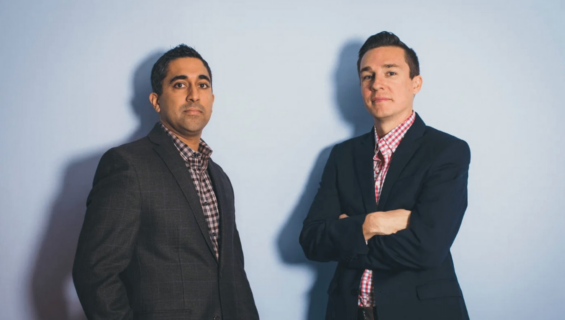
Vheda Health co-founders Shameet Luhar, CEO, and Philip Rub, president.
Balance Theory raised $19 million in August and said it plans to hire directly out of Maryland’s intelligence-community workforce.
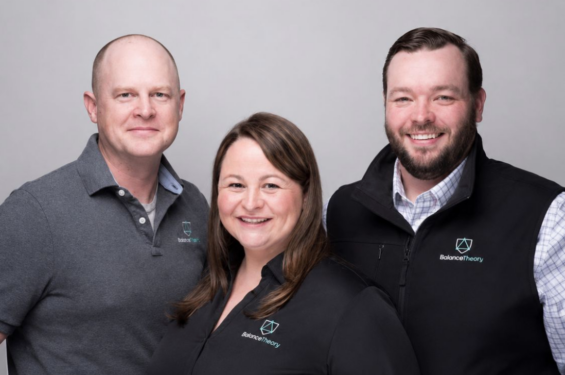
Balance Theory co-founders, from left: Nathan Necaise, Lisa Mathias, and Greg Baker.
Neither fits the government-contractor mold our old reputation assumes. Both are product companies built on the very resources the September panel identified as difficult to commercialize in Maryland: deep federal-adjacent technical talent and a research base few places can match.
Our own programming is designed to put that proof in front of people rather than just describe it. The Cyber Howard Accelerator accepts applicants from anywhere in the country, not only Maryland, and its most recent cohort winner drove in weekly from Philadelphia to build a post-quantum cryptography platform. We’ve found that you don’t argue a skeptical founder out of defaulting to Boston or the Bay Area. You put them in the building for twelve weeks and let the work make the case.
We’ve also invested in the connections that make all of this usable in the first place. Our Investor Summit at MIC pulled investors from across the Mid-Atlantic into a single room. And our financial partners have become part of the working infrastructure rather than names on a banner: Fulton Bank’s Life Sciences & Technology team brings sector-specific financing to our medtech and life sciences founders, the kind of early-stage lending most traditional banks won’t touch. Tower Federal Credit Union, supports the Cyber Howard Accelerator as a sponsor and invests in the broader cyber talent pipeline, including through a scholarship partnership with UMBC’s Cyber Scholars Program. Together, these efforts help connect the capital, talent, and resources that growing companies need to succeed.
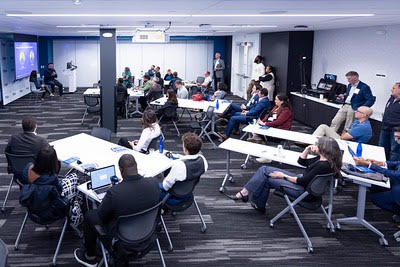
Connecting people, capital, and expertise is part of the work of helping Howard County’s innovation economy grow.
What we’re betting on
Columbia itself was built on the idea that a place could be planned into existence rather than stumbled into. Nearly sixty years later, our economic development approach is a version of the same bet: the raw material is already here at a concentration almost nowhere else has, and what’s left is assembling it into something that compounds.
The Gateway Master Plan puts that bet on paper. The harder work is turning the vision into a place where companies grow, research becomes commercial success, and talent chooses to stay.A storytelling problem gets fixed with better stories. A reputation problem gets fixed by results that move faster than the reputation does.
We’re focused on building those results, confident that the story will become harder to ignore.