SPARK Internship Program Connects Emerging Talent with Real-World Experience
Employers Told Us Where the Gaps Were. SPARK Worked Backwards From There.
Ask a cybersecurity or AI company in Howard County what limits their growth, and talent comes up fast. Not a shortage of interested people but a shortage of people who arrive ready.
Employers here have been direct about it. Candidates come out of strong programs and still land short on the specific credentials the work requires and still have not started the security clearance process that many of these roles depend on. Clearance alone can take 18 months to two years. When a graduate begins that process on their first day, the company waits two years for a fully deployable hire.
Starting with the employer
Howard County has robust internship and apprenticeship programs. What it did not have was a program built backwards from named roles at named companies.
That was the design idea behind SPARK, Skilled Pathways for Apprenticeships, Readiness and Knowledge. The Howard County Economic Development Authority built it with the County Executive’s Office, the Office of Workforce Development and Health Tech Alley, and the sequence begins with the employer. Companies in the county’s growth sectors, cybersecurity, artificial intelligence, quantum and adjacent emerging technology, describe the roles they are trying to fill and the gaps they keep seeing. Participants are matched to that, then prepared for it.
The program runs in three phases. A two-week professional readiness accelerator. Four to six weeks of industry-recognized credential work. Then three to six months of work-based learning on live projects.
Two elements do most of the work. Participants pursue certifications while they are still enrolled, rather than after graduation when the lift is heaviest. And several begin the security clearance process early, moving a two-year timeline forward by years.
What the work looked like
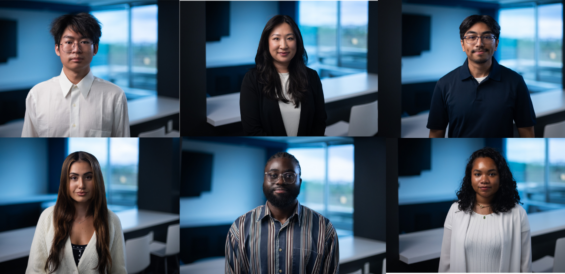
At RealmOne, Steven Galo built out infrastructure for local AI model runs and made an LLM backend interchangeable across a mock environment, a local Ollama model and AWS Bedrock, so the team could test without cloud costs. Steven Galo has also passed the CompTIA Security+ certification.

Jaleen Loving worked on a proof-of-concept AI-assisted penetration testing platform pairing a chat interface with an agent running standard tooling inside a sandboxed environment.
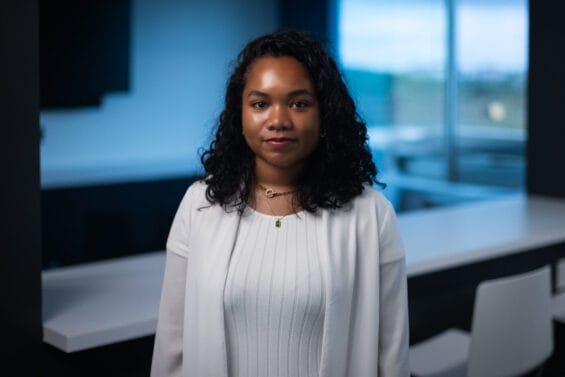
At Digiflight, Reavin Zhan built quantum workflows and submitted jobs to IBM quantum hardware, implementing the Bernstein-Vazirani algorithm in Qiskit with 980 of 1,024 hardware shots returning the target string. Reavin Zhan also passed the AWS Cloud Certified Practitioner Exam.

Julia Kim, who previously ran a hair-styling business and is now finishing a cybersecurity degree, maintained and scaled a CI/CD deployment pipeline. Julia Kim has also passed the CompTIA Security+ certification.

Liana Mosheyev redesigned the data structure behind a Salesforce business development modernization effort. Liana was also recently granted her full Secret Clearance.

At Capital Energy Solutions, Precious Akinrotoye built an AI grant intelligence pipeline that ingests Grants.gov data, scores opportunities against the company’s own capability document on seven weighted criteria, and drafts client proposals from a chat prompt.
Why this matters for businesses here
For an employer, the return is not goodwill. It is a longer look at candidates than any interview provides, project work that advances real priorities, and a pipeline that arrives credentialed and clearance-eligible instead of two years away from it.
That is the argument for doing business in Howard County more broadly. The county sits inside one of the densest cyber and defense corridors in the country, close to federal customers and a deep research base. What turns proximity into advantage is whether local companies can actually hire against it. Building that capacity is part of what EDA is for.
Workforce is one line in a longer list. EDA works with companies on financing, site selection, permitting navigation, and growth support through the Maryland Innovation Center. Many businesses in the county still do not know those resources exist. That is worth fixing before your next hire, not after.